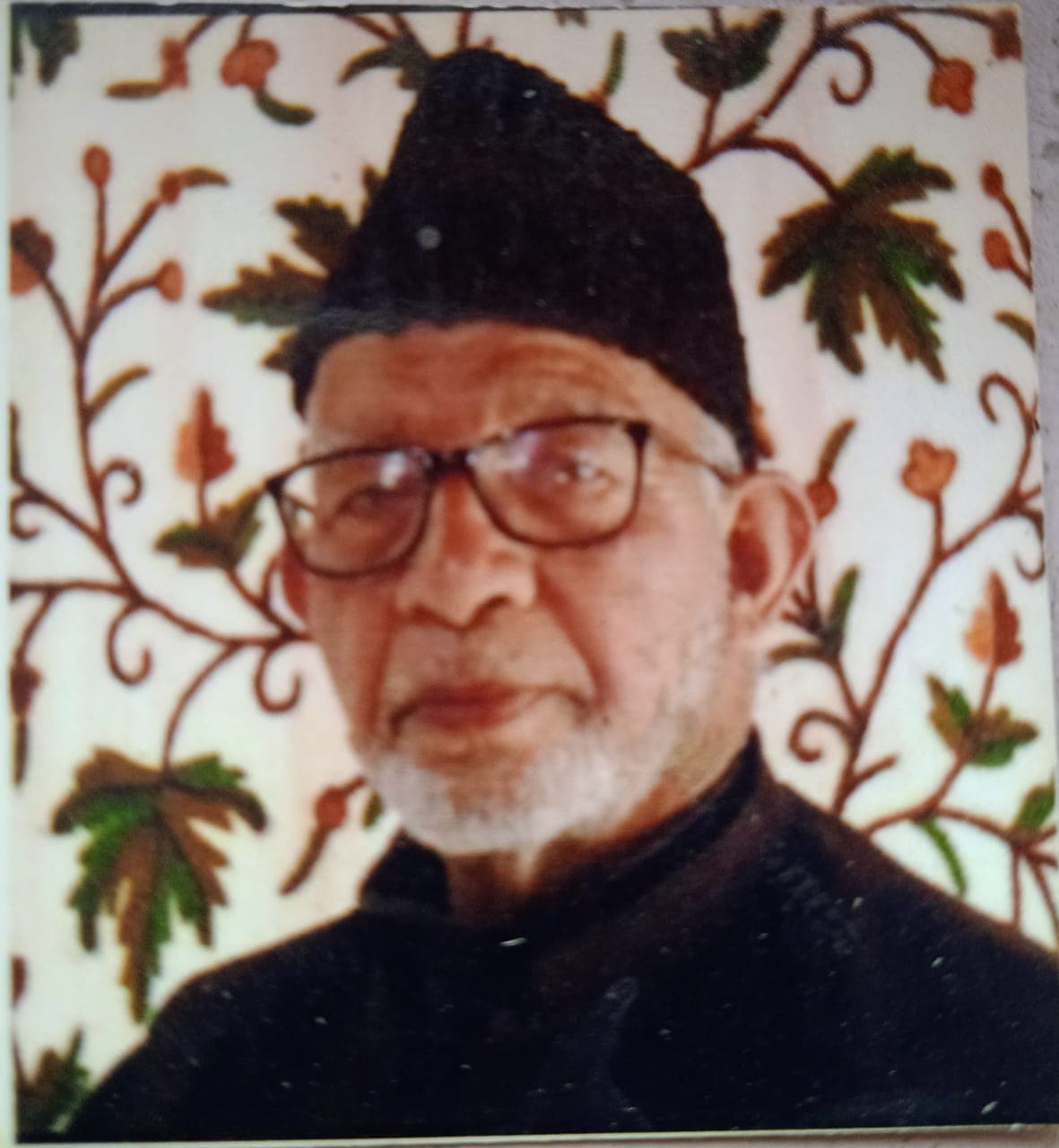
A Journey of Patience and Devotion
Mir Abdul Majeed's father, Mir Ghulam Mohammad, was known across Srinagar as “Naqshgeer,” a master engraver of silver and copper. When his father fell suddenly ill, twelve-year-old Abdul Majeed left school to support his family, joining a crewel embroidery workshop to learn a trade. He mastered the craft quickly, and before long was training other young apprentices at a workshop of his own.
In 1968, a British embroiderer working in Srinagar offered him Japanese staple yarn for use in Aari work. What began as an experiment became an innovation: his success with the material established Aari staple embroidery as a technique in its own right, and the demand it created eventually brought staple-yarn manufacturing to India.
In the decades that followed, his work travelled far beyond Kashmir, exhibited in Kolkata, Mumbai, Delhi, and beyond, and recognised with a State Award for Excellence for his embroidered picture “Dancing Girl in Paddy Harvest.” Today, as founding chairman of the Kashmir Artisans Welfare Organisation and of Wirasat, he continues to train new artisans and champion Kashmiri craft on a national stage.
The Art of Aari Embroidery
Aari embroidery is a centuries-old Kashmiri technique using a hooked needle to create dense, flowing chain stitches, a method Mir Abdul Majeed has practiced and refined for more than six decades.
Unlike embroidery worked with a straight needle, Aari work uses a fine hooked tool that pulls thread from beneath the fabric, letting an artisan build dense, continuous patterns with remarkable speed and fluidity. In 1968, Mir Abdul Majeed pioneered the use of staple yarn within this technique, an innovation that changed the way Aari embroidery was practiced across the region.
He later introduced calligraphy into embroidery, a rare application of the craft that has found its way into mosques and homes alike. Each piece still begins the traditional way: a hand-drawn outline, filled stitch by stitch over many days, in patterns of florals, paisleys, and chinar leaves rooted in the Kashmiri landscape.
Awards & Recognition
Pioneer of Aari Staple Embroidery
Introduced staple yarn into Aari embroidery for the first time, an innovation that reshaped the craft across Kashmir and, as demand grew, brought staple-yarn manufacturing to India.
First Position, Kashmir Arts Emporium
Awarded first position and a cash prize at the Kashmir Arts Emporium, Srinagar, for the embroidered artwork “Apple Selling Kashmiri Girl.”
Registered Craft Unit & National Trade
Registered his workshop with the State Directorate of Handicrafts and began showcasing and trading embroidered work across India, including Kolkata.
Krishna Nagar Utsav, West Bengal
Specially invited to exhibit at the Krishna Nagar Utsav, organised by the West Bengal Directorate of Cottage & Small Scale Industries with the Ministry of Textiles, where his work received extraordinary appreciation.
Exhibition in Mumbai
Invited by the All India Port and Dock Workers Federation to exhibit his art in Mumbai.
State Award 2017: Certificate of Excellence
Conferred the J&K Directorate of Handicrafts and Handlooms’ State Award 2017 (1st Prize) for the embroidered picture “Dancing Girl in Paddy Harvest.”
Invited Supplier, Central Cottage Industries Corporation
Invited by the Central Cottage Industries Corporation of India to supply his embroidered work to the Corporation.
Master Craftsman, Karkhandar Scheme
Appointed Master Craftsman under the state’s Karkhandar Scheme, training newly recruited young artisans from Kashmir, Mumbai, Bengal, and Ladakh.
Interviews & Features
Moments where his craft has been recognised and shared beyond the workshop.